VO2 Max: Is Your Endurance Predestined, or Can You Build It?
About 50% of your maximal oxygen capacity is set by genetics before you ever lace up a shoe. The HERITAGE Family Study proved that two people can follow identical training programs and see wildly different results. Here is what the science actually says, and how to maximize the half that is yours to control.

If you have ever watched an elite marathon runner glide effortlessly at a pace that would hospitalize most people, or seen a Tour de France cyclist push impossible watts for hours, you have probably wondered: how much of that is luck, and how much is pure grit?
In exercise science, we measure this "endurance potential" using a metric called VO2 Max: the maximum volume of oxygen your body can utilize during intense exercise. It is the single most powerful predictor of cardiovascular fitness, and one of the strongest independent predictors of longevity in the research literature.
Recent science has generated significant buzz with a powerful statistic: roughly 50% of your VO2 Max is genetic.
Is this figure accurate? And if so, does it mean half of your athletic destiny was written before you ever trained? The truth is nuanced, deeply encouraging, and surprisingly complex.
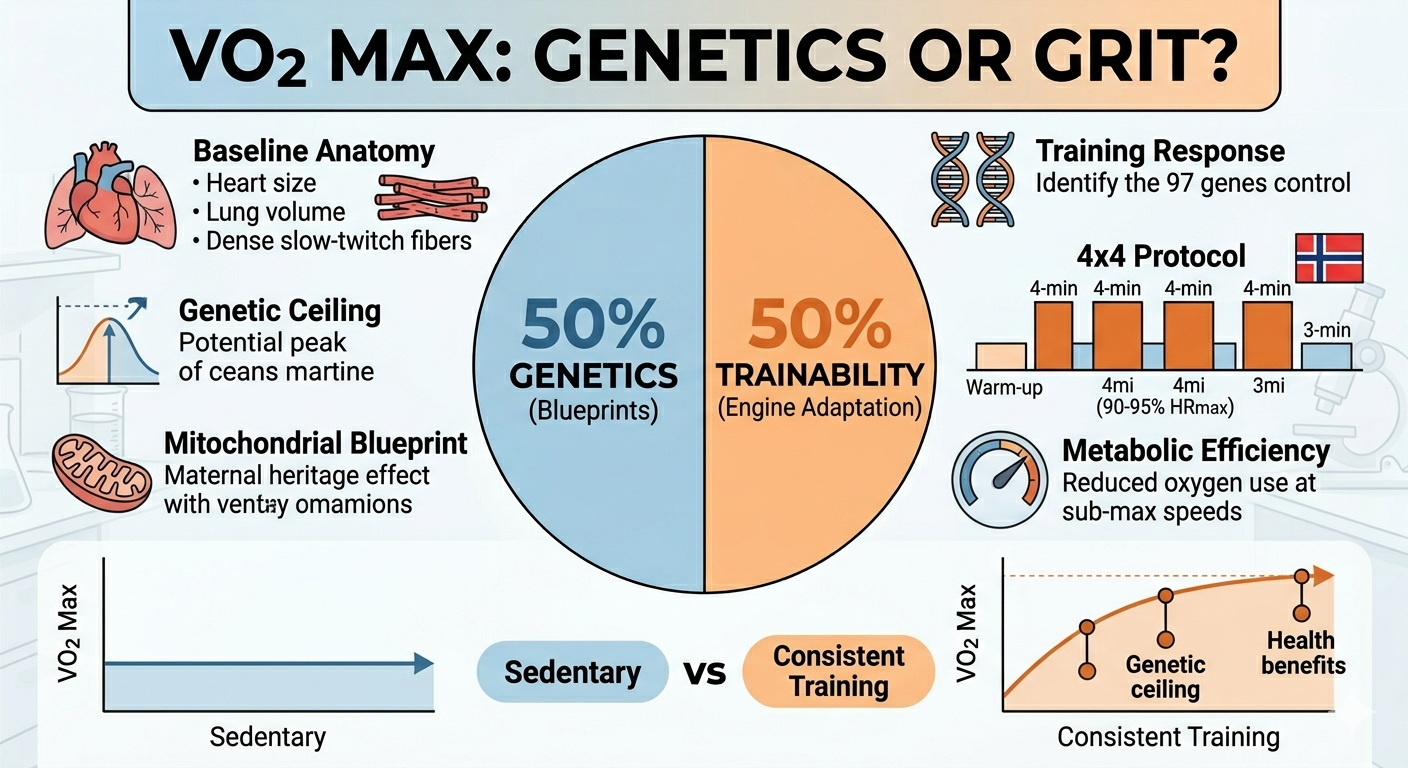
The Great Split: Genetics vs. Training Adaptation
The infographic framing is accurate: roughly half of your capacity is defined by your starting blueprints, while the other half is defined by how hard and how consistently you run the engine.
- Baseline heart stroke volume and chamber size
- Natural lung volume and diffusion capacity
- Density of slow-twitch (Type I) muscle fibers
- Mitochondrial density ceiling (maternal inheritance)
- Capillary network architecture in working muscles
- Your genetic "trainability ceiling" for aerobic gains
- Mitochondrial proliferation (more power plants per cell)
- Increased stroke volume from cardiac remodeling
- Upregulated aerobic enzymes (citrate synthase, etc.)
- New capillary growth (angiogenesis) in muscles
- Enhanced movement economy at sub-maximal efforts
- Reduced oxygen cost for the same speed or power
Both sides are real. Your genes set the architectural limits; your training determines where between the floor and the ceiling you actually operate.
Deep Dive: Unpacking the DNA Blueprint
To understand where this "50% genetic" rule comes from, we have to look at the landmark studies that shaped modern exercise genomics.
1. The HERITAGE Family Study
The standard figure originates from a massive, multi-decade international research effort known as the HERITAGE Family Study, led by exercise physiologist Claude Bouchard. The study took hundreds of sedentary participants from nearly 100 different families and put them through an identical, highly standardized 20-week cycling program.
The headline finding was not simply that some people have higher VO2 Max starting points. It was something far more striking: people respond vastly differently to the exact same training program.
All three groups followed the identical 20-week cycling program with perfect compliance. The difference in outcome was not effort. It was genetics. Family members tended to cluster in the same response tier.
High responders saw their VO2 Max shoot up by over 40 to 50%. Low responders followed the same routine with perfect compliance and saw almost zero improvement in absolute aerobic capacity. When the researchers analyzed families, they found that roughly 47 to 50% of your capacity to respond to training is also genetic. If a parent or sibling was a high responder, others in the family were statistically likely to match that high-response curve.
This was not a flaw in the training design. It was biology.
2. The Matrilineal Link: Mitochondrial DNA
The HERITAGE study also highlighted a unique genetic twist: a 28% maternal transmission effect specifically for aerobic performance. This is not a metaphor. It has a precise molecular explanation.
from the egg
Mitochondria are the powerhouses where oxygen becomes ATP. Because you inherit them only from your mother, looking at your maternal lineage gives a clearer picture of your natural aerobic baseline than your paternal side does.
Mitochondria are the literal powerhouses where oxygen is converted into usable energy (ATP). Because mitochondrial DNA is inherited exclusively from your mother, your baseline aerobic capacity carries a unique maternal fingerprint. If you are trying to understand your natural cardio ceiling, your mother's athletic history is a more direct data point than your father's.
3. Genomic Mapping and the 97-Gene Signature
As genomic technology advanced, a massive genetic mapping meta-analysis (Timmons et al., 2010) moved past broad family statistics to isolate specific DNA sequences. Scientists identified a 97-gene signature that controls how your body adapts to aerobic training. These genes regulate everything from how easily your heart tissue remodels (pumping more blood per beat) to how rapidly your muscles build new capillary networks under exercise stress.
Critically, none of these genes are "on" or "off" switches. They are all continuous variables. Even a person with low-responder genetics is still running all 97 genes. The question is simply how sensitively those genes react to a training stimulus.
Moving the Needle on the Other 50%
Genetics set both your starting floor and your trainability ceiling. Where you actually operate between those two points is entirely determined by your training and lifestyle. Even for low responders, there is meaningful room to move.
1. Build Movement Economy First
Even if your absolute VO2 Max number feels stubborn, consistency builds one thing that genetics cannot: extreme movement efficiency. The more hours your heart rate is elevated in training, the better your body becomes at utilizing oxygen at sub-maximal efforts. In practical terms, this means you can run faster or sustain higher power while using a smaller fraction of your VO2 Max ceiling, saving precious capacity for the moments you need it most.
Elite distance runners are not always the people with the highest VO2 Max. They are often the people with the best economy: the lowest oxygen cost per mile at race pace. Economy is highly trainable even when the ceiling is not.
2. Force the System with the Norwegian 4x4 Protocol
To truly push your aerobic ceiling higher, you must spend meaningful time working at or very near your peak aerobic capacity. Sustained steady-state cardio builds a base but rarely pushes the ceiling. The highest-evidence method for doing so is the Norwegian 4x4 Interval Protocol, validated in multiple randomized controlled trials and widely used in elite endurance training.
Total session time is approximately 38 to 40 minutes. 2 to 3 sessions per week is the validated dose. The 3-minute active recovery between intervals is intentional: enough rest to hit 90-95% again on the next bout, but not so much that your cardiovascular system fully returns to baseline.
The protocol works for two reasons. First, the intensity requirement (90 to 95% HRmax for 4 full minutes) is high enough to recruit every aerobic adaptation pathway simultaneously. Second, the incomplete recovery forces your heart to sustain a high-output state for an extended cumulative duration each session.
3. The Sedentary-to-Active Jump
While elite athletes train 20 to 30 hours per week for single-digit percentage gains at the margin, the largest single percentage jump in VO2 Max and the greatest reduction in all-cause mortality happen when a sedentary person starts doing anything consistently.
The largest absolute jump in VO2 Max and all-cause mortality risk happens at the transition from sedentary to "anything consistently." You do not need to become an endurance athlete. Moving from zero to moderate activity captures the overwhelming majority of the cardiovascular and longevity benefit.
You do not need to chase elite numbers. Research consistently shows that going from completely sedentary to moderately active captures most of the longevity benefit, including improved insulin sensitivity, lower resting blood pressure, improved mitochondrial density, and meaningful gains in biological age metrics.
Genetics may hand you the blueprints to the engine. You still have a firm foot on the accelerator. The job is to understand which engine you have, and drive it well.
What This Means in Practice
If you are a low responder to traditional steady-state cardio, do not interpret a slow VO2 Max gain as failure. Your movement economy and metabolic efficiency are still improving. The cardiovascular health benefits (lower ApoB, better insulin sensitivity, reduced inflammation) accumulate regardless of whether your VO2 Max number moves dramatically. Chase the biology, not only the number.
If you want to know your aerobic trainability profile in advance, genomic testing that includes the ACTN3, PPARGC1A, and ACE gene variants can give you a rough prior. But no genetic test replaces a proper measured VO2 Max from a graded exercise test, which tells you exactly where you sit today, regardless of your inherited blueprint.
The 50% that is yours to build is real, measurable, and large enough to matter significantly for health and longevity. Consistent Zone-2 work for movement economy, 2 to 3 high-intensity sessions per week at 90 to 95% HRmax, and adequate recovery between hard efforts are the evidence-backed levers. Genetics may set the ceiling; you determine the floor.
Get research like this in your inbox.
Weekly notes on longevity science, exercise physiology, and biomarkers, written without the hype. Free, and you can unsubscribe anytime.
No spam, affiliate promotions, or shared email lists.
Cardiorespiratory fitness is one of the strongest longevity predictors we track.
VO2 Max, ApoB, insulin sensitivity, and HRV tell a connected story about cardiovascular aging. Your Antiaging Labs protocol includes specific Zone-2 and HIIT prescriptions calibrated to your current fitness data, not a generic template. Follow-up testing tells you whether your engine is responding.
Build your baseline →References
- Bouchard, C., et al. (1999). Familial aggregation of VO2max response to exercise training: results from the HERITAGE Family Study. Journal of Applied Physiology, 87(3), 1003-1008.
- Bouchard, C., et al. (2011). Genomic predictors of the maximal oxygen uptake response to standardized exercise training programs. Journal of Applied Physiology, 110(5), 1160-1170.
- Timmons, J. A., et al. (2010). Using molecular classification to predict gains in maximal aerobic capacity. Journal of Applied Physiology, 108(6), 1487-1496.
- Wisloff, U., et al. (2007). Superior cardiovascular effect of aerobic interval training versus moderate continuous training in heart failure patients. Circulation, 115(24), 3086-3094.
- Albright, D., & Klevjer, M. (2024). Half of VO2 Max Is Genetic: How to Move the Needle on the Other 50%. SuperAge.